
Child's Play

Quantico, VA
5:00 AM, August 1986
The Sergeant Instructor stood in front of our five-member fire team and read the order from his clipboard. We could make out his helmeted form by the dim glow of his red-filtered flashlight.
“The bridge in front of you has been blown up,” he started, pointing toward a man-made gully. “The unit on the other side is pinned down and low on ammunition. Your mission is to deliver these supplies using only what is in front of you.”
We had been up most of the night, logging miles with full packs through the thick Virginia woods to confront one challenge after another. Even in our groggy state, the fabricated stakes of the challenge energized us into a collective focus.
“You have ten minutes, starting now.”
We took stock of our supplies: A 2x12 board that only bridged ⅔ of the fabricated river, a rope that was maybe as long as the gap, and the ammo box. We took a few minutes to talk through options and come up with a plan. A few false starts, a quick regroup to recalibrate and adjust the plan, and four and a half minutes later, we were done. Childsplay.
Never mind that we were one of the early classes of women to be trained in these kinds of tactics. Or that the Marine Corps was still trying to figure out how much they could ask from us, or how we would respond to the demands. We had been training for this kind of collaborative problem-solving our whole lives. Probably, you have too.
If you don’t believe me, just watch a group of children at a playground. It could be a dozen lifelong friends (i.e, all five years of their lives). More likely, it’s a makeshift gang of whoever showed up that morning - different ages, different backgrounds, different temperaments. It doesn’t matter. We are social animals, and our interactions follow a universal dynamic of brainstorming, trial and error, and group problem-solving.
“No, how about we …” one child might suggest (if it’s a girl, she’s called bossy).
“I know,” another will chime in. “Let’s just …”
“Hurry! …” a dramatic one will add to the scene.
It doesn’t matter if they’re trying to build a tower with sticks, dam up the runoff from yesterday’s rain, or defend their jungle gym from alien attackers. Humans learn at an early age how to work together to create, build, or defend.
This innate social interaction was on full display the other day, when Mark and I joined a group of volunteers for the Community Beautification Day at The Fells, a nearby historic home. Some people came with rakes and leaf blowers to clear dirt roads and do trail maintenance. Others brought trowels for weeding the rock garden. Mark worked with our neighbor building trellises. I was assigned to the potting group, which included the new college intern and the octagenarian who had been tending the gardens for half a century; two master gardeners and those of us who were grateful for the sticks in the pots that named the flowers we were to plant.
We weren’t delivering life-saving ammunition or protecting The Fells from aliens, but the conversations had the same feel of people working together to accomplish something. “Let’s add another dahlia to this pot.”
“Does anybody have a knife to open the bag of mulch?”
Mark and I had taken the morning shift. As we left, more folks were joining the evolving team – picking up leaf blowers, rakes, trowels, and paintbrushes to continue the mission.
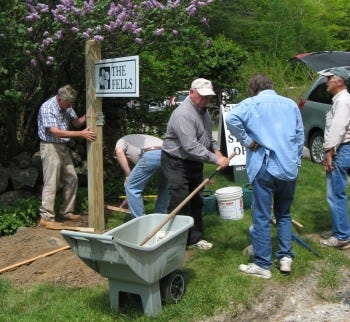
Teamwork makes the dream work.
Important lessons for how we educate our kids and build community.