
How Hard Can It Be?

“A job takes as long as a job takes.” My father-in-law, Jim, says this more as a reminder to himself than to others. Ever since my husband was old enough to use power tools, his father liked to do “we-jobs” – jobs that Jim would plan, and Mark would do. Jim pitched in with the manual labor himself, but he appreciated the advantage of youth when it came to muscle power and endurance. The latter was important, because Jim’s we-jobs often took a weekend or two, not the morning they were budgeted for. But Wood boys are not ones to scrimp on quality. They are capable craftsmen, and, fortunately, they don’t charge by the hour. If the rest of the family became impatient when the Plymouth small-block V8 engine occupied the garage for the summer while it was being rebuilt, they were met by Jim’s sage observation about the nature of jobs and how long they took.
Underestimating the demands of a given endeavor is not unique to the men in my family. A project always looks easier from the outside than from the middle of it. We see people (other people) tackle all sorts of activities with aplomb while they hold down jobs, raise families, or pursue a graduate degree. “How hard can it be … to repair that old dresser, host a dinner party for eight, plan a vacation, write a novel?”
Much harder than you think! Is this disconnect between a task and the resources it demands a case of underestimating the job’s difficulty, or overestimating one’s ability? Probably both. The Greeks called this hubris; Freud called it ego; the nuns just called it pride. Charles Darwin recognized that “Ignorance more frequently begets confidence than does knowledge.” For a contemporary example, look for the recent retiree the next time you’re at a cocktail party. You know, the one who’s going to build a boat in his backyard and write his autobiography.
There’s a name for this inverse relationship between confidence and ability. The Dunning-Kruger Effect explains that people who are new to a skill will overestimate their ability to master it. Ironically, once someone starts learning, he understands how much daylight there is between what he knows and what he needs to know, and his confidence plummets. Eventually, new skills lead to genuine confidence. I am a frequent flyer on this rollercoaster of ignorance to enlightenment, and it is not a one-way ride. The tug-of-war between confidence and competence is an ongoing dance and, along the way, a few missteps can leave us scrambling to regain our rhythm.
Many of the tasks we set out to do will kick our ass and send us running to the sofa and the latest season of The Bachelor. Not the men in my family. They know that a difficult task demands that you set a clear goal, learn from mistakes, and stick with it for the duration, however long that may be. Because, “a job takes as long as a job takes.”
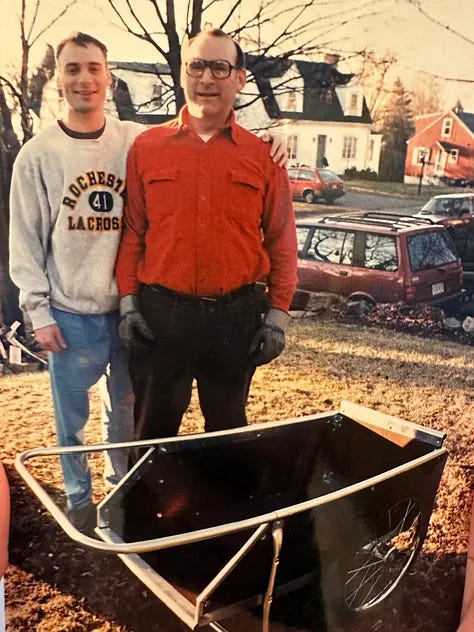


I love this story. I also love the pictures!