
White Space

“Busy.” That’s how most people answer when asked how they’ve been. They’ll run through where they’ve been or what they’ve done. But what about the time between appointments, meetings, and to-do lists? Nobody talks about the white space in our calendars, the downtime between one event and another, the boring times before the next thing.
I remember Sunday mornings in my childhood home, waiting for the rest of the family to be ready for church. I’d sit down at the piano to play for a few minutes – maybe spin through Soffregietto or the introduction to The Entertainer – while my sisters finished their hair or my brother scrounged for a tie.
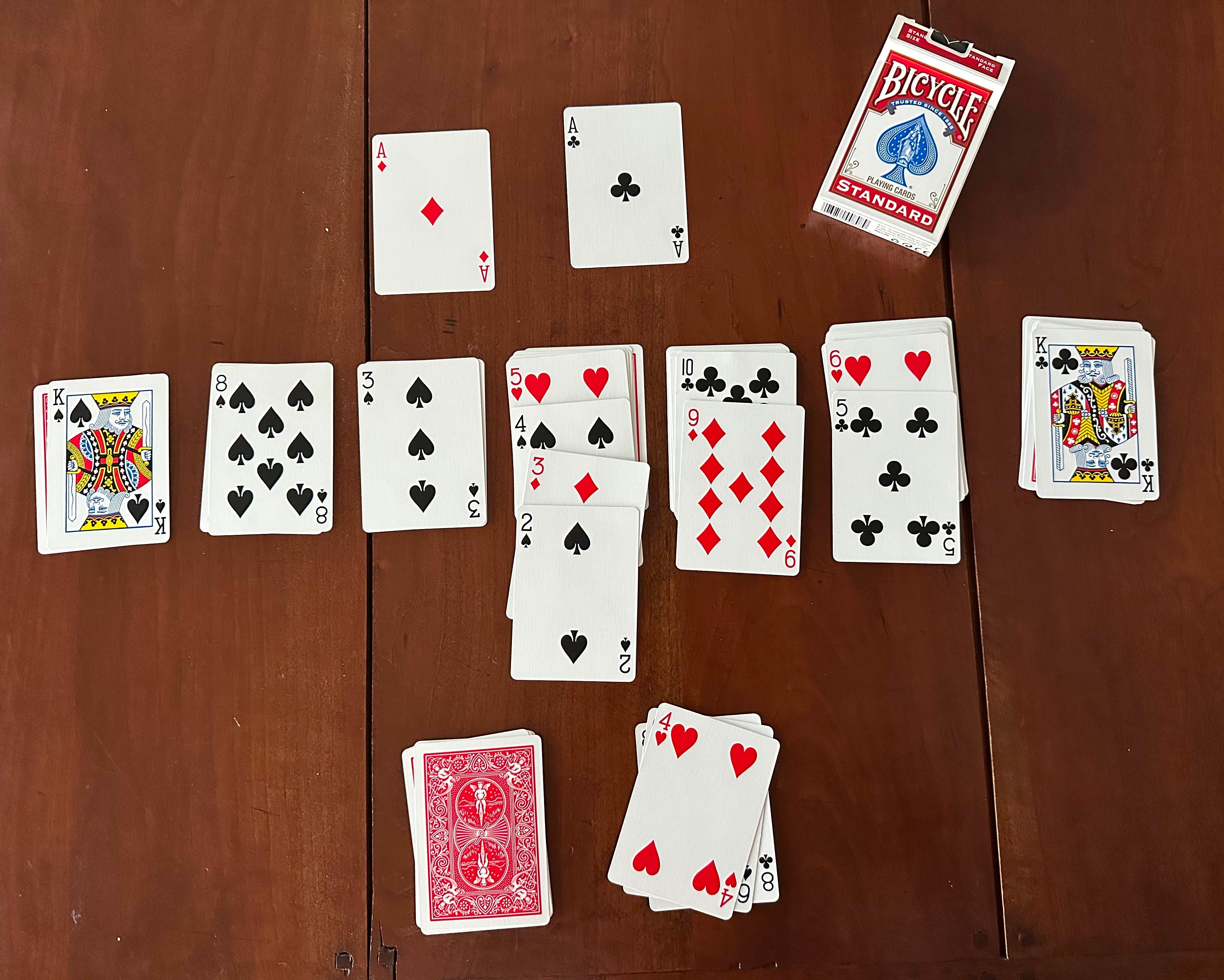
My mother, who certainly was busy raising her clan of children, understood the value of stolen moments. On long summer days at our camp, she’d take advantage of the rare quiet occasion while her kids were off catching frogs or picnicking on the bluff. After cleaning up the remnants of the fluffernutter sandwiches and before the boiled potatoes were cool enough to mix with mayonnaise and chopped celery, Mom might sit on the porch and lay out 7 neat piles of softened Bicycle playing cards, turning the top one over to begin her solitary game. Who knows what matters she might have been contemplating as she moved cards from one space to another, red on black on red, straightening them as she played.
My youngest, Jackson, shares his grandmother’s fondness for cards. When he was little, he’d pass the time between when I told him we were leaving for the grocery store and the time I’d actually be ready to leave by building a house of cards. He could keep track of the comings and goings of my departure preparations while he considered forces of friction and moment arms, adjusting his design with each attempt.
Other people have more to show for their downtime. My mother-in-law would keep her knitting on hand during car rides or while sitting in hockey arenas, pausing a conversation to count stitches or consult a pattern, or halting her progress to yell at her son to keep his stick on the ice. At the end of a stretch of highway, or between periods, she’d mark her place with a giant safety pin, returning to it in time.
I don’t think people are busier than they used to be, but our sense of downtime – how much we have and how we spend it – has shifted since my mother’s time. Who needs a deck of cards when we have apps for countless, quick games to be played in isolation? The meditative act of shuffling, then bridging the deck back into order, then shuffling some more, has been replaced by a single swipe or a verbal command. But, unlike the tacit obedience to a phone’s next offering, analogue activities are deliberate, a choice rather than just a habit.
Moreover, they are generative, not merely consumptive. It is no accident that the constant feed on our phones does not culminate in anything. It leads us from one snippet to another and leaves us with nothing but the vague notion that we have wasted time. No completed mitten thumb, smoother arpeggio, or chapter of a hero’s journey.
I miss my piano, but I’m not sure how much I would play it. I rarely have to wait for anyone to get ready for anything. But I might start keeping a deck of cards near my kitchen table as a way to pass some time while the potatoes cool.
love it!
There is a lot of wisdom in this piece, Tracy (as in many of your posts): "generative, not merely consumptive" speaks volumes.